
How to launch a crypto casino on a white label platform
Crypto payments connected on day one, wallets in the coins you choose, a catalogue that leans towards the crash and slot titles crypto players look for — and a plain account of what crypto does not change.
What is a white label crypto casino?
An online casino that takes deposits and pays withdrawals in cryptocurrency, run on a platform the operator rents rather than builds. The operator brings the brand, the licence and the traffic; the platform supplies the games, the wallets, the payment integrations and the back office.
On WW Games, crypto is the default rather than an add-on. Four crypto payment providers come connected with every launch, and fiat methods are added on top for the markets a brand actually serves. A crypto-first brand can go live without a card processor at all, which is often the point.
The rest of the product is the same as for any other brand on the platform: the game catalogue, bonuses, the VIP programme, tournaments and the Telegram Mini App. What a white label includes in general is on the white label casino page.
Which crypto payment providers come connected?
NOWPayments, PayRam, Banxa and CryptoBot, with every launch and at no separate charge. Between them they cover direct crypto deposits and withdrawals, card payments that settle in crypto, and payments inside Telegram.
Connecting a new gateway and its keys is done by our team; the admin panel then switches each channel on or off, per wallet currency and per direction. How each channel is shown, ordered and labelled per currency is covered on payments.
- NOWPayments
- Deposits and withdrawals in the coins the operator enables from its catalogue. The admin panel shows the gateway's live balance and can convert between coins before a payout.
- PayRam
- A second crypto channel, plus a card route that lets a player pay in fiat while the casino receives crypto.
- Banxa
- Card to crypto for players who have no wallet yet — the usual first deposit for someone new to crypto.
- CryptoBot
- Telegram's payment bot, for deposits and withdrawals without leaving the messenger.
Which coins and currencies can players use?
Any coin the operator adds from the NOWPayments catalogue, plus the fiat currencies enabled for the brand. Players can hold wallets in several currencies at once and switch between them; reporting runs in US dollars.
Adding a coin fills in its network, address format and precision automatically. For each one the operator sets a minimum withdrawal and whether withdrawals are allowed in it at all — a coin can be accepted for deposits and paid out in another, which keeps the payout side down to the coins the treasury actually holds.
Accounting in dollars, with exchange rates refreshed every hour and rate history kept per currency, is what makes a multi-coin casino readable. GGR, bonus cost and payment volume come out in one unit instead of a column per coin, and a player's USDT, BTC and TON balances are comparable on one screen.
Which coins to offer is a question about the audience. Stablecoins such as USDT are what most players keep a balance in, because the value of a bet does not move while they play; the volatile coins are worth adding where players already hold them.
What about players who have no crypto?
They pay by card through Banxa or PayRam, and the casino receives crypto. Direct card and bank channels can also be connected for a market, once a provider agrees to work with the brand.
A crypto casino that only accepts crypto limits itself to players who already own some. Card-to-crypto closes most of that gap without the brand needing a card acquirer of its own: the player sees a card form, the provider handles the conversion, and the deposit lands in the wallet like any other.
How are crypto withdrawals paid out?
The player requests a withdrawal, the amount moves from their balance into escrow, and staff approve or decline it. On approval the coins are sent through the gateway; on decline they return to the player's balance.
Withdrawals are not automatic, and for crypto that matters more than usual: an on-chain payout cannot be called back. Approving and declining are separate permissions, and each asks for a fresh two-factor code at the moment of the action.
If the gateway lacks the coin the player asked for, the admin panel creates a conversion first and approves once it has finished. If the send fails after approval, the amount goes back to escrow and the request can be retried, so nothing is lost between the ledger and the chain.
A player on a fraud hold cannot create a withdrawal at all. Multi-accounting and bonus abuse are the costly problems in crypto casinos, where sign-up is cheap and payouts are fast — what the platform flags and how a hold works is on anti-fraud.
Which games does a crypto audience expect?
Crash and instant-win games, high-volatility slots and live dealer tables. The catalogue has 73 studios, including Spribe, the studio behind Aviator, along with Aviatrix, SmartSoft Gaming, Galaxsys and Onlyplay for crash titles, and Hacksaw Gaming and Nolimit City for slots.
Crypto players skew towards fast rounds and visible multipliers, which is why crash games sit at the top of most crypto lobbies. They are also the easiest product to show in a thirty-second advert, which matters to whoever is buying the traffic.
WW Games has no in-house games; every title comes from a studio. Provably fair verification, where a game offers it, is a feature of that studio's game rather than of the platform, so check the specific titles you plan to promote. Which studios accept your markets and your licence is a separate check, covered on game providers.
How do crypto casinos keep players?
Mostly with rakeback: a share of the house edge on every bet, paid back at a rate that rises with the player's VIP rank. It pays on volume rather than on losses, which suits players who bet often.
On WW Games rakeback is calculated as bets × house edge × the rank's percentage, and the ranks themselves come from XP earned on real-money bets and deposits. There is no loss-based cashback. The full mechanics are on VIP programme.
Slot tournaments and deposit bonuses run alongside it. A crypto audience compares offers across brands quickly, so a rakeback rate a player can see on their VIP page tends to work harder than a large welcome bonus with heavy wagering.
How does crypto work in the Telegram Mini App?
Through the same wallet and the same providers as the web casino. CryptoBot and TON suit the channel best, because the player already has them in the messenger. Telegram Stars can be enabled as a top-up, but cannot be withdrawn.
Crypto and Telegram tend to arrive together: an audience spread across several countries, used to wallets inside the messenger, and reached through channels rather than search. The Mini App ships with every launch, on the same backend and the same account. How players find it and what happens if a bot is restricted is on Telegram casino.
Do you need a licence to run a crypto casino?
Paying in crypto does not change the licensing question; your markets decide it. Licensing is the operator's responsibility and depends on the markets they serve. WW Games does not hold or sublicense a gambling licence, and can put operators in touch with licensing providers.
What differs is which licences sit comfortably with crypto. The Anjouan regulator lists cryptocurrency-enabled gaming among the activities its licence covers, which is why it is common among crypto-first brands. A Costa Rica structure alone usually limits a casino to crypto and high-risk payment providers.
Game studios and payment providers check the licence too, crypto ones included. The jurisdictions are compared on licensing.
What does a crypto casino cost, and how long does it take?
A setup fee from $5,000 and a revenue share from 7% of GGR, with no minimum term. The four crypto providers are part of the setup, not an extra. The platform side takes about a week from agreed requirements to production.
The live date is usually set by your side: the licence, the provider agreements and the brand decisions. A crypto-only launch tends to be the quickest of all, because it skips the longest item on most plans — waiting for a card acquirer to approve the brand.
What the price covers and what it does not is on pricing.
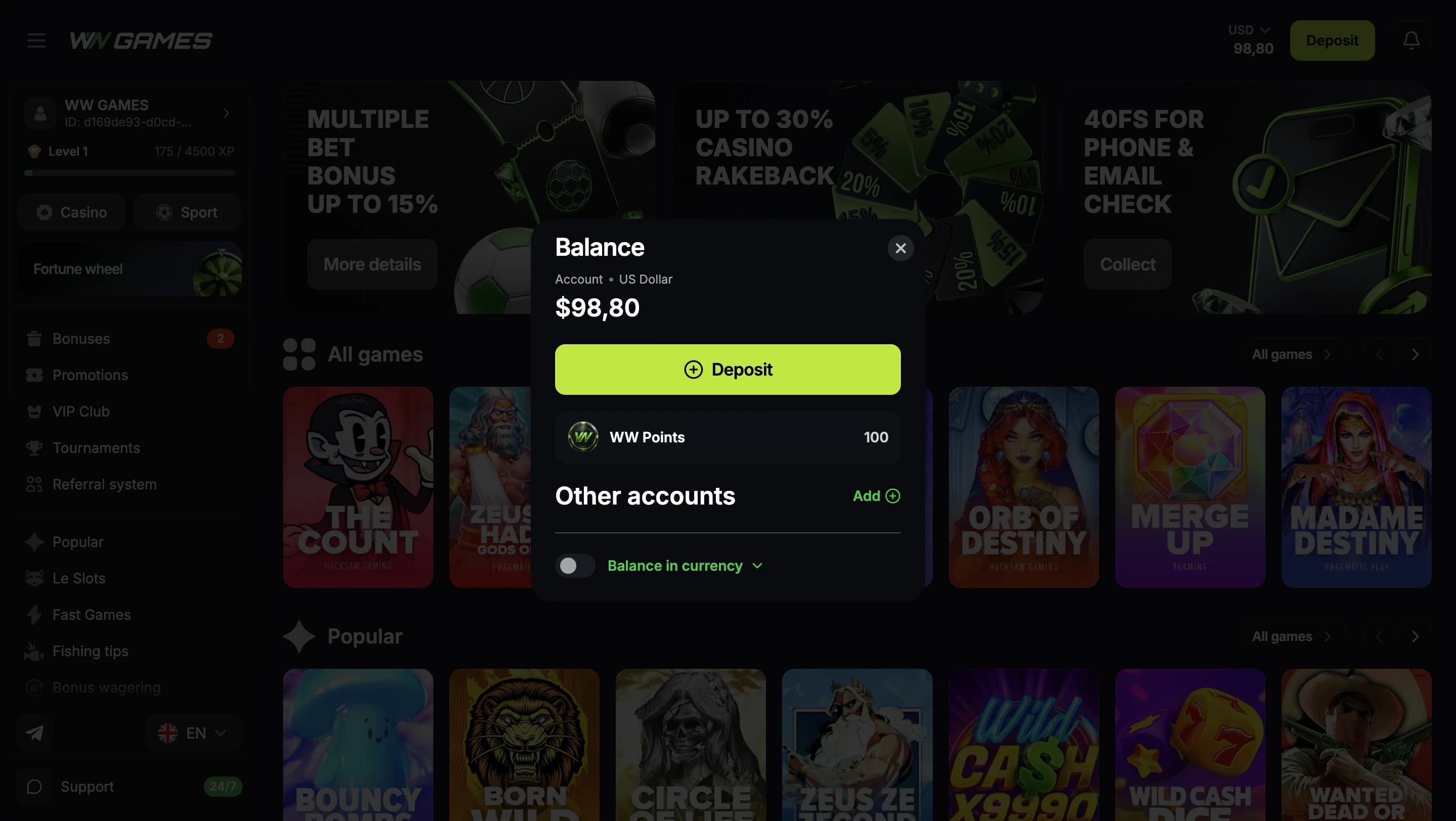
The balance window
A player's balance with the option to add wallets in other currencies, crypto coins included.
Read next
Crypto casino questions
Can a casino on WW Games launch with crypto payments only?
Yes. NOWPayments, PayRam, Banxa and CryptoBot come connected with every launch, so a brand can go live without a card processor. Fiat channels can be added later for specific markets.
Can players deposit in one coin and withdraw in another?
Yes. For each coin the operator decides whether withdrawals are allowed in it, so a coin can be accepted for deposits and paid out in another. Reporting is in US dollars across all of them.
Are crypto withdrawals automatic?
No. Each withdrawal is held in escrow and approved or declined by staff with that permission, confirmed with a two-factor code. On-chain payouts cannot be reversed, so the check comes before the send.
Does the platform have provably fair games of its own?
No. WW Games has no in-house games; the catalogue comes from 73 studios. Provably fair verification, where a title offers it, is provided by the studio that makes it.
Is a crypto casino cheaper to run?
The platform price is the same — from $5,000 setup and from 7% of GGR. Payment fees are usually lower than on cards, and since the revenue share is calculated before payment fees, that saving stays with the operator.
See the crypto side running
Tell us which coins and markets you have in mind; we will show a deposit and a withdrawal end to end, the per-coin settings and the gateway balances in the admin panel.